

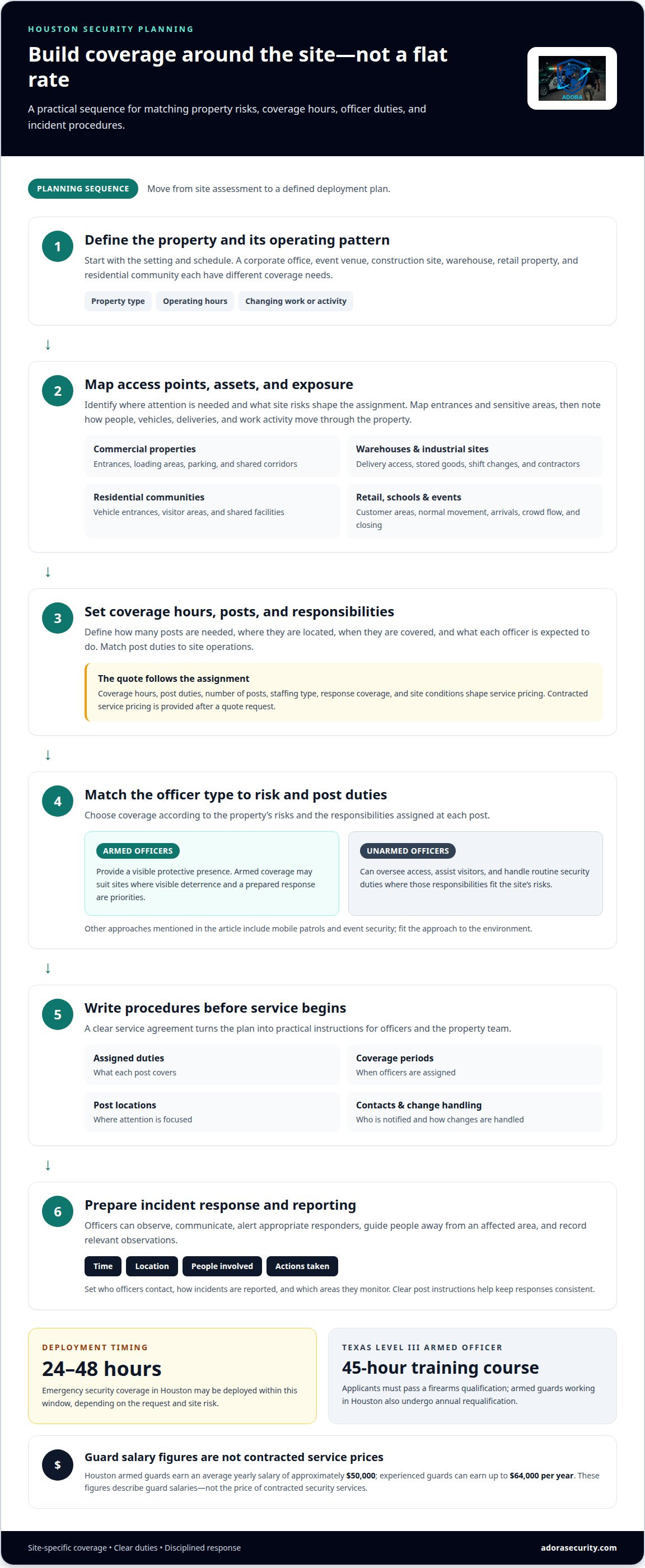
The right level of protection starts with the site, not a flat rate. Emergency security coverage in Houston may be deployed within 24 to 48 hours, depending on the request and site risk. The cost of armed security guards in Houston depends on factors such as coverage hours, property layout, risk exposure, and assigned duties.
It’s reasonable to want clear coverage without disrupting daily operations. This article explains how assignment and response needs shape armed security guards in Houston, which properties may benefit from armed protection, and how officers handle incidents in higher-risk settings. You’ll also see how patrols, access control, and on-site presence can support a practical security plan.
Key Takeaways
- Assess coverage needs by looking at site layout, operating hours, risk exposure, and the duties officers will perform.
- Identify the areas of a property where an armed presence may support deterrence, access oversight, and day-to-day continuity.
- Understand how officers can observe, communicate, and respond to incidents while keeping procedures disciplined and focused.
- Match the security approach to the environment, then consider whether armed officers, unarmed officers, mobile patrols, or event security best fit the need.
Security service affordability and responsiveness
Security budgets depend on the assignment, while response planning starts with site risk and requested coverage. In Houston, staffing needs differ between a corporate office, an event venue, and a construction site.
Guard Salaries and Service Costs
Houston armed guards earn an average yearly salary of approximately $50,000, and experienced guards can earn up to $64,000 per year. These figures describe guard salaries, not the price of contracted security services. Service pricing depends on the assignment and is provided after a quote request; coverage hours, post duties, and site conditions shape the quote. Compare the planned coverage and responsibilities, not salary figures alone.
Factors Shaping Service Quotes
A security plan should reflect the property, schedule, and officers’ duties. A construction site may need attention to entry points and changing work activity, while a corporate property may prioritize visitor access and consistent post coverage. The number of posts, armed or unarmed staffing, and response coverage also shape deployment. Defining the scope helps align officer duties with operations.
Armed officers provide a visible protective presence; unarmed officers can oversee access and handle routine security duties. The right choice depends on the property’s risks and each post’s responsibilities. Houston properties that may benefit from armed coverage include event venues, businesses, and residential communities. Define the setting, coverage schedule, and officer duties in the security plan.
To plan security, define the property, schedule, and main concerns. A useful service agreement describes assigned duties, coverage periods, post locations, response procedures, and how changes are handled. These details clarify the deployment before service begins.
For properties in Houston and Conroe, deployment planning should account for location, access points, and required coverage. Share the property type and operating schedule so the plan fits the assignment, whether it involves a corporate facility, event, or residential setting.
Houston industries and properties needing armed protection
Protection needs vary by property, operating schedule, and exposure. A retail center, warehouse, residential community, and industrial facility each have distinct access points, traffic patterns, and assets to protect. Armed coverage may suit sites where visible deterrence and a prepared response are priorities. Other locations may need unarmed officers for routine access oversight and visitor assistance.
Commercial property managers can assess entrances, loading areas, parking, and shared corridors. At a warehouse, officers may focus on delivery access and movement around stored goods. An industrial facility may need coverage coordinated with shift changes and contractor access. Retail properties may prioritize entrances, customer areas, and closing procedures. Define each post’s purpose to suit the specific property.
Residential security should protect residents while keeping daily routines orderly. ADORA Security provides armed and unarmed security officers and residential patrols for communities and properties. Identify the locations and times that need attention, such as vehicle entrances, visitor areas, or shared facilities. Unarmed coverage may suit routine access duties; the choice should reflect site risks and assigned responsibilities.
Construction sites, schools, and event venues also face changing conditions. Construction activity shifts by work phase, so the plan should account for active work areas and entry procedures. Education facilities need security arrangements that respect normal movement through the property. Event organizers can plan for arrivals, crowd flow, and closing. Clear coverage boundaries help officers focus on relevant areas.
To shape a practical plan, map key entrances, describe operating hours, and identify sensitive areas or assets. Then match armed and unarmed coverage to the duties at each post. A property security assessment can help organize these site-specific priorities into a deployment plan.
Security officer duties and incident response
In Texas, a Level III Commissioned Security Officer is an armed guard. This officer is authorized to carry a firearm while on duty. Level III applicants must complete a 45-hour training course and pass a firearms qualification. Armed guards working in Houston also undergo annual requalification. These steps support readiness, but daily duties still depend on the assigned post.
Credentials vary by role. The U.S. Bureau of Labor Statistics says guards who carry weapons usually must hold a license from the appropriate government authority. Texas Level IV Personal Protection Officers receive additional executive protection training and must undergo psychological evaluations. These credentials relate to distinct duties; Level IV describes personal protection, not a general upgrade for every property assignment.
On a commercial post, officers can monitor entrances, observe activity, and document concerns. A camera or surveillance system may provide useful context, while an officer can assess what is happening on site. For example, an unusual vehicle near a restricted entrance may prompt observation, communication, and a written incident report. Clear post instructions help officers respond consistently.
During an incident, officers focus on immediate safety and communication. They can alert appropriate responders, guide people away from an affected area, and record relevant observations. A report should document the time, location, people involved, and actions taken. At a construction site, for example, an officer can report unauthorized access and notify the designated site contact.
What are the legal limits on armed guards’ use of force in Texas? Carrying a firearm does not give an officer unrestricted authority to use force. Any response must comply with applicable law and the officer’s assigned procedures; force is not a tool for punishment or intimidation.
Before deployment, define who officers contact, how they report incidents, and which areas they monitor. Set expectations for camera and surveillance observations, escalation, and documentation. Specific procedures help each officer understand the assignment and support a coordinated response when conditions change.
Armed security guards for high-risk environments
Higher-risk sites need a plan built around specific exposure, not the same post at every entrance. A Houston warehouse with restricted storage, a construction site with equipment, and a property handling valuable goods present different concerns. First identify vulnerable areas, operating hours, and access patterns. Then decide where an officer’s presence, patrols, or monitoring can support daily operations.
For a property with several access points, map public entrances, loading areas, and restricted zones. Give each post a clear purpose, such as observing deliveries or discouraging unauthorized entry. Mobile patrols can cover areas that don’t need a fixed officer throughout the shift. At a construction site, the deployment plan can account for changing work areas and equipment locations as activity moves.
Coordination matters when conditions change. Set out how officers communicate with site contacts, record concerns, and escalate incidents. For example, a property manager may know which loading entrance has recurring access issues; that detail can guide patrol routes and post instructions. Cameras can add context to observations, but responsibilities still need to be clear. Specify who reviews alerts and receives incident updates.
A service agreement should connect the security plan to the property. Define post locations, coverage periods, patrol responsibilities, communication steps, and how assignment changes are handled. Include relevant site procedures, such as contractor entry rules or restricted areas. ADORA Security uses these details to develop deployment plans that align officer duties with site operations, rather than relying on broad instructions.
For high-risk properties, begin with a focused assessment of access points, valuable assets, and coverage gaps. Request a security assessment to develop a deployment plan around the site’s specific operating conditions.
ADORA Security: Armed security officers
ADORA Security provides armed security officers for Houston properties that need an on-site protective presence and defined incident procedures. Where an armed post isn’t necessary, unarmed officers can handle routine security duties. Mobile patrols can cover multiple areas, while event security can help manage guest entry and activity.
The right assignment begins with the site’s operating needs. Share the property type, access points, coverage schedule, and main concerns so the deployment plan reflects the setting. A commercial property may prioritize entrances and shared areas, while an event may need attention to guest flow. These practical details align officer responsibilities with the activity being protected.
If your Houston property needs a structured security plan, contact ADORA Security to discuss the site and its coverage needs.
Set the Next Shift Up for Success
Make the next step a practical planning decision. Identify who needs protection, which areas require attention, and how security coverage should fit around normal operations. This gives ADORA Security a clear basis for planning officer duties and communication procedures before deployment.
For properties considering armed security guards in Houston, ADORA Security provides armed and unarmed officers and mobile patrols. The right mix depends on the site’s priorities: a fixed post, routine patrol coverage, or both. Clear expectations keep protection aligned with daily activity and help avoid unnecessary disruption.
Bring your property type, schedule, and key concerns into the conversation. Contact ADORA Security to discuss coverage and outline a security approach for your site. A measured plan can help your team move forward with greater clarity and confidence.
Frequently Asked Questions
What services do armed security guards in Houston provide?
Armed officers can provide fixed-post security, access control, visible deterrence, mobile patrols, and event protection. Assignments may cover commercial, industrial, residential, educational, or construction properties. At an event, duties can include entry screening and crowd management; on a construction site, officers may oversee gate access and equipment areas. Houston-area plans can also include monitored alarm response when it fits the deployment.
How much do armed security guards cost per hour in Houston?
The service price depends on the assignment and is provided after a quote request. Coverage hours, post duties, property layout, risk exposure, and staffing needs shape the estimate. Define the schedule and officer responsibilities clearly to understand the proposed scope. Ask that the proposal explain the coverage period and any minimum shift commitment, so you can assess how the service fits your operations.
What Texas licenses and training are required for armed security guards?
Texas Level III Commissioned Security Officers are armed officers authorized to carry a firearm while on duty. Applicants must complete a 45-hour training course and pass a firearms qualification; armed guards working in Houston undergo annual requalification. Level IV Personal Protection Officers receive additional executive protection training and must undergo psychological evaluations. Level IV applies to personal protection work, a distinct role from routine property assignments.
How can I verify a Houston security company's Texas DPS license?
Use Texas Department of Public Safety licensing records to look up the company’s exact legal name or license number. Match the listed business identity and status with the company named in the proposed agreement. Distinguish company credentials from individual officer qualifications. For an armed assignment, review the credentials of the officers assigned, not only the security company’s business record.
What qualifications should I look for when hiring armed guards in Houston?
Look for credentials suited to the assignment, firearms qualification, and relevant experience in similar settings. The U.S. Bureau of Labor Statistics says guards who carry weapons usually must be licensed by the appropriate government authority. For a warehouse post, discuss access oversight and incident reporting; for an event, consider experience with guest entry and crowd management. Clear communication and disciplined documentation matter, too.
What factors affect armed security guard prices in Houston, including minimum hours and overtime?
Coverage duration, assigned duties, site layout, staffing, and operational risk can shape the service quote. Minimum hours and overtime terms can also affect the total. The written proposal should state whether a minimum shift applies, how additional hours are calculated, and which duties fall within scheduled coverage. Review those terms alongside post locations and the schedule to understand the full assignment.
