

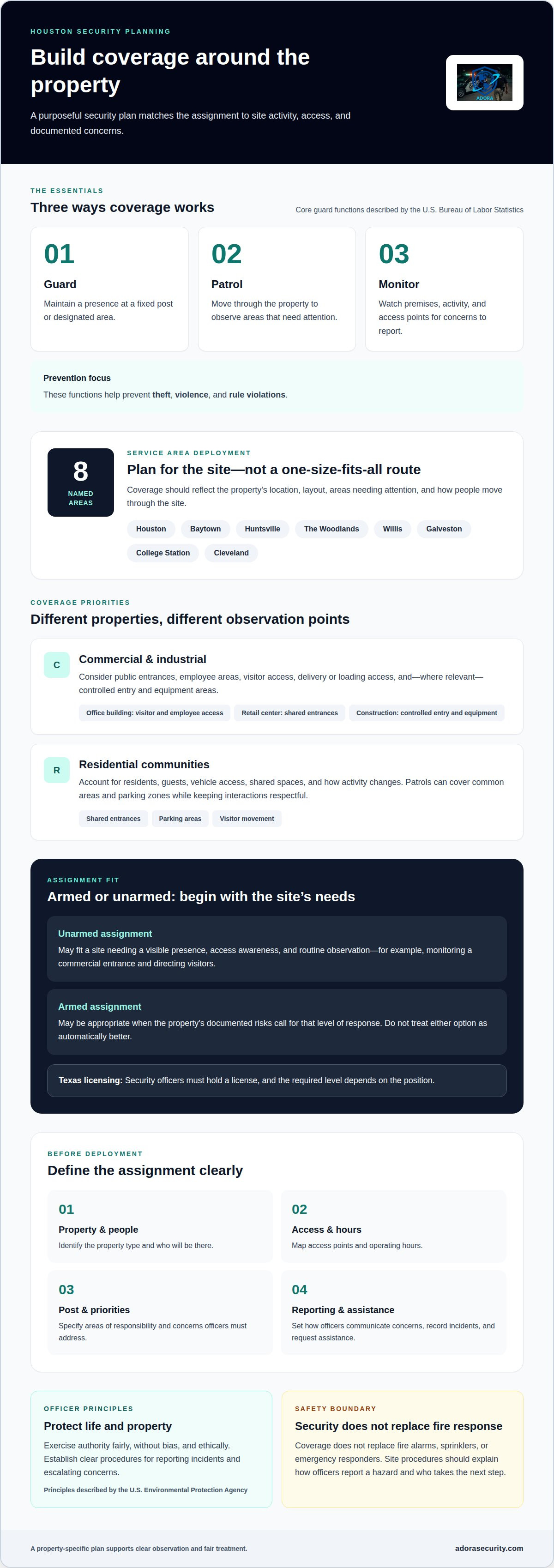
Protection works best when it fits the property and the people who use it. A Houston security officer may guard, patrol, or monitor premises to help prevent theft, violence, or rule violations, according to the U.S. Bureau of Labor Statistics. Texas requires security officers to hold a license, with the required level depending on the position.
Choosing between armed and unarmed coverage, or deciding what a commercial site or residential community needs, starts with understanding the work involved. This guide explains what security services can include, how armed and unarmed assignments differ, and what to consider when exploring local job openings. It also shows how property needs shape a security plan, from a visible on-site presence to mobile patrols, so you can identify the right next step for your work search or property.
Key Takeaways
- Security guards can guard, patrol, or monitor premises to help prevent theft, violence, and rule violations, according to the U.S. Bureau of Labor Statistics.
- In Texas, security officers need a license, and the required level depends on the position.
- Match the coverage approach to the property: commercial sites and residential communities have different access, activity, and patrol needs.
- A security officer’s role includes protecting life and property while exercising authority fairly, without bias, and ethically, according to the U.S. Environmental Protection Agency.
Houston security guard services
Houston properties need security coverage shaped around daily activity and access points. The U.S. Bureau of Labor Statistics says security guards guard, patrol, or monitor premises to help prevent theft, violence, or rule violations.
Service Area Deployment
A deployment plan can take account of a property’s location, areas needing attention, and how people move through the site. A residential community may need patrols around shared entrances and parking areas, while a commercial property may prioritize its main entrance and loading access. Conditions vary across Houston, Baytown, Huntsville, The Woodlands, Willis, Galveston, College Station, and Cleveland, so the plan should reflect each site’s layout rather than assume one approach fits every property.
Security Officer Duties
A security officer’s work can include guarding a fixed post, patrolling a property, or monitoring premises. At a Houston site, the assignment should identify the areas to observe and the concerns to report, such as unauthorized entry or a rule violation. Clear post instructions help keep attention on the property’s actual needs. The U.S. Bureau of Labor Statistics describes these functions as ways guards help prevent theft, violence, or rule violations.
A sound security plan emphasizes prevention, awareness, and fair treatment. An officer monitoring a shared entrance, for example, can observe access and activity while residents, employees, and visitors go about their routines. Priorities differ by setting: a busy commercial entrance and a residential parking area call for different observation. Define those priorities in the deployment plan.
Fire and safety planning also needs clear boundaries. Security coverage does not replace fire alarms, sprinklers, or emergency responders. Property procedures should explain how officers report an observed hazard and who takes the next step. A site plan, for example, can identify the reporting contact and explain how officers communicate an urgent concern. Keep these procedures aligned with the property’s safety arrangements.
Unarmed and armed security positions
Texas requires security officers to hold a license, with the required level depending on the position. The U.S. Environmental Protection Agency describes an officer’s role as protecting life and property while exercising authority fairly, without bias, and ethically. These principles matter when deciding whether an armed or unarmed assignment fits a property.
An unarmed assignment may suit a site that needs a visible presence, access awareness, and routine observation. At a commercial entrance, for example, an officer can monitor who enters and direct visitors to the appropriate area. An armed assignment may be appropriate when the property’s documented risks call for that level of response. Choose based on the site’s needs, not an assumption that one option is always better.
Start by defining the assignment. Consider the property type, who will be there, access points, operating hours, and the concerns officers must address. A construction site with controlled entry has different priorities from an education facility with regular visitor traffic. Match the position to those priorities, then establish how officers communicate concerns, record incidents, and request assistance.
Use-of-force expectations require deliberate attention. Establish clear procedures for reporting incidents and escalating concerns, and ensure the assignment calls for fair, ethical treatment. The EPA emphasizes protecting life and property without bias. This supports a measured approach: an officer’s presence should help maintain order while respecting the people who work, live, or visit there.
Before deployment, align the post instructions with the selected position and the property’s operating procedures. A security assessment and deployment plan can help organize those decisions around the site’s specific risks. The result is a more purposeful assignment, whether the property calls for an unarmed presence or armed coverage.
Texas requires security officers to hold a license at the level appropriate to the position. Their role should be to protect life and property while exercising authority fairly, without bias, and ethically.
Texas requires a license, with the required level depending on whether the position is armed or unarmed. The appropriate level follows the assignment and the property’s needs.
Officers should protect life and property while exercising authority fairly, without bias, and ethically. Assignments should establish clear procedures for reporting incidents and escalating concerns, with careful attention to use-of-force expectations.
Commercial and residential security
Commercial properties and residential communities have different routines, access patterns, and security priorities. At a Houston office building, attention may center on visitor entry and employee access. In an apartment community, residents, guests, parking areas, and shared spaces shape the assignment. Map who uses each area and when activity changes.
For commercial and industrial sites, match coverage to daily operations. A retail center may need a visible presence near shared entrances, while a construction site may need attention on controlled access and equipment areas. Choose an armed or unarmed assignment based on the site’s specific risks, not by default. Define the post, areas of responsibility, and reporting process before deployment.
Residential security calls for a different balance. Patrols can cover common areas and parking zones while keeping interactions respectful and community-minded. A residential community, for example, may prioritize entrance activity during visitor arrivals and routine checks of shared spaces. Clear instructions help officers distinguish ordinary resident activity from concerns that need reporting.
- Commercial: Identify public entrances, employee areas, and delivery access.
- Residential: Map shared spaces, vehicle access, and visitor movement.
- Both: Set post instructions and communication steps around the property’s routines.
For either property type, review the plan when operations or site conditions change. A new delivery entrance at a business can alter access patterns. Renovations in an apartment community can create temporary routes and restricted areas. Update the assignment to reflect these changes, then clarify which areas officers observe and how they report concerns. This keeps coverage aligned with the site instead of treating every property the same.
What does a security officer do in Houston?
A security officer’s duties depend on the assigned property and post instructions. At a Houston commercial entrance, the role may include observing arrivals, directing visitors, and reporting access concerns. At a residential property, the focus may shift to shared spaces and vehicle activity. Instructions should specify which areas officers cover and how they communicate observations.
Observation is active work. An officer can note unusual activity, identify an access issue, and report it through the site’s established process. If a delivery arrives at a restricted entrance, for example, the officer follows property instructions rather than assuming it is authorized. Clear procedures help employees, residents, and visitors know what to expect.
According to the U.S. Environmental Protection Agency, an officer’s role includes protecting life and property and exercising authority fairly, without bias, and ethically. In practice, that means applying site rules consistently. Visitors, employees, and residents should receive the same respectful treatment in the same circumstances. Professional conduct supports order without making routine interactions unnecessarily confrontational.
Houston-area assignments can involve different environments and activity patterns. At a school, officers may focus on visitor access and movement through designated areas. At a construction site, attention may center on authorized entry and site activity. Post instructions should connect each location’s priorities with specific reporting steps, so officers know what to observe and whom to notify.
For property managers, useful instructions identify the post, coverage area, access procedures, and reporting contact. They should also explain how officers coordinate with the property’s existing safety procedures. This gives a Houston security officer a defined role instead of a vague expectation to “keep watch.” Review the instructions when operations or access arrangements change.
Need a defined plan for your property? Arrange a security assessment to align officer duties with site priorities.
ADORA Security
ADORA Security helps property owners across Houston, Conroe, Baytown, Huntsville, The Woodlands, Willis, Galveston, College Station, and Cleveland match coverage to their site, activity, and priorities. Armed or unarmed officers can support a defined on-site assignment, while mobile patrols suit properties needing patrol-based coverage. Event security addresses the distinct needs of organized gatherings. The right fit depends on the environment, access points, and officers’ responsibilities.
Turn to ADORA Security when you’re weighing armed versus unarmed coverage, planning patrols, or arranging event security. Discuss your property and its operating needs to shape a practical deployment plan. Contact ADORA Security to talk through the right approach for your Houston-area property or event.
Set a Clear Direction for Your Property
Turn security concerns into clear priorities. Identify the areas needing attention, the people who use them, and how officers should report concerns. This gives a Houston security officer a defined role and helps keep coverage aligned with daily operations.
ADORA Security provides armed security officers, unarmed security officers, and mobile patrols. The right approach depends on your property’s needs and the duties you want covered. A focused discussion can clarify your priorities and shape a practical plan for your site.
Discuss your security needs with ADORA Security and take a considered next step toward a more orderly, well-supported property.
Frequently Asked Questions
What Houston companies are hiring security officers?
Houston-area security job opportunities may come from providers such as ADORA Security and organizations that staff their own properties. Employers may need coverage for commercial buildings, residential communities, schools, construction sites, or events. Local searches can include Houston and nearby communities such as Conroe, Baytown, The Woodlands, and Galveston. Compare the duties and work setting described for each role.
What are the typical duties and qualifications in Houston security officer jobs?
A Houston security officer may guard a fixed post, patrol a property, monitor activity, or support access control. Duties vary by assignment: an event role may focus on entry procedures, while a construction-site role may involve observing site access. Texas requires security officers to hold a license, with the required level depending on the position. Match the job’s duties to its stated license requirements.
What is the difference between an armed and unarmed security officer in Texas?
An armed officer’s assignment includes carrying a firearm; an unarmed officer’s does not. The appropriate role depends on the property’s security needs and the duties involved, rather than a general preference for one option. Texas requires security officers to hold a license, with the required level depending on the position. Consider the position and its licensing level when comparing roles.
What rules govern security officers and use of force in Texas?
Texas security officers need a license, and the required level depends on the position. Officers should protect life and property while exercising authority fairly, without bias, and ethically. Assignments should include clear procedures for reporting incidents and escalating concerns.
